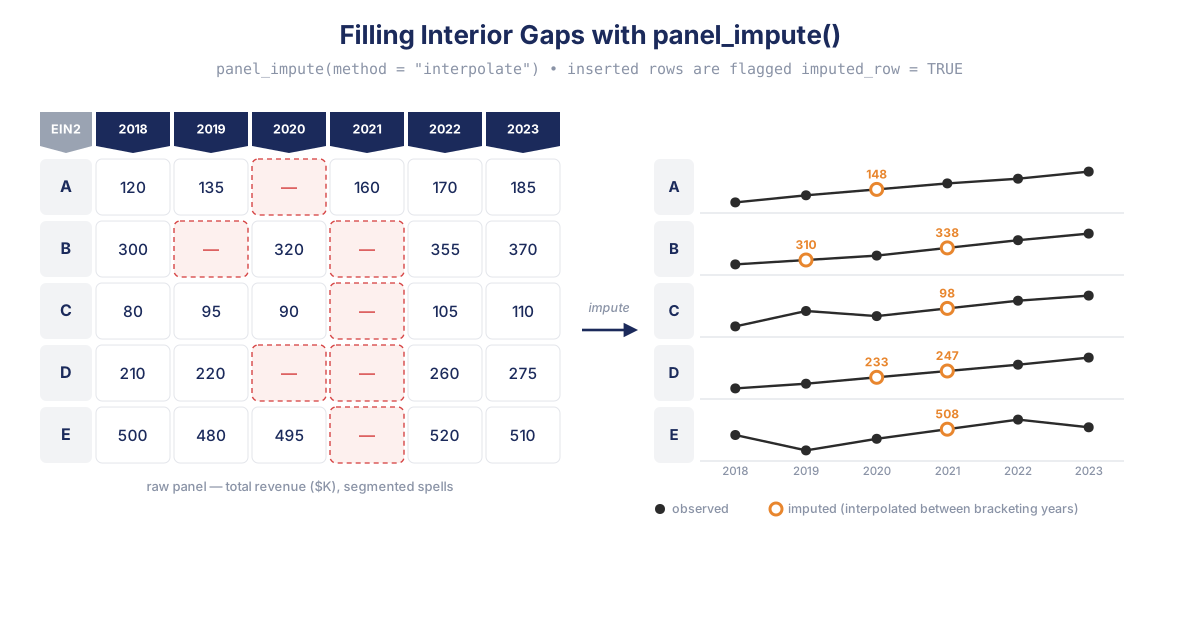
panel_impute() is the low-level engine that inserts a
panel’s missing interior years and fills their numeric fields
from the observations that bracket each gap. (For the researcher-facing
“just complete every span” verb, see panel_complete() in
Completing panel spans.)
A year can only be inserted if it is part of the panel, so our toy
data has a filler organization F observed every year, and
one organization A that skips the middle:
df <- data.frame(
  EIN2     = c("A", "A", "F", "F", "F", "F"),
  TAX_YEAR = c(2018, 2021, 2018, 2019, 2020, 2021),
  revenue  = c(0, 30, 5, 5, 5, 5)
)
A spans 2018–2021 but is missing 2019 and 2020 –
persistent on the boundary axis, segmented on
the spell axis:
attr(panel_describe(df, print = FALSE), "classification")[, c("EIN2", "panel_type", "panel_spell")]
#>   EIN2 panel_type panel_spell
#> 1    A persistent   segmented
#> 2    F persistent    seamless
Fill methods
The gap between A’s 2018 value (0) and 2021 value (30)
can be filled four ways. Compare them on the two missing years:
fill <- function(m) {
  out <- panel_impute(df, vars = "revenue", method = m)
  out$revenue[out$EIN2 == "A" & out$TAX_YEAR %in% c(2019, 2020)]
}
data.frame(
  year        = c(2019, 2020),
  mean        = fill("mean"),        # flat average of the brackets
  interpolate = fill("interpolate"), # linear between the brackets
  locf        = fill("locf"),        # last observation carried forward
  nocb        = fill("nocb")         # next observation carried backward
)
#>   year mean interpolate locf nocb
#> 1 2019   15          10    0   30
#> 2 2020   15          20    0   30
mean (the default here) puts the same average in every
hole; interpolate draws a straight line; locf
holds the prior value; nocb pulls the next value back.
Imputation never extends past an organization’s own span, and a hole
stays NA only when both brackets are missing.
Which organizations are eligible
By default only persistent organizations (those that
span the window) are imputed, and every gap is filled:
out <- panel_impute(df, vars = "revenue")     # method = "mean", types = "persistent"
out[out$EIN2 == "A", c("TAX_YEAR", "revenue", "imputed_row")]
#>   TAX_YEAR revenue imputed_row
#> 1     2018       0       FALSE
#> 2     2019      15        TRUE
#> 3     2020      15        TRUE
#> 4     2021      30       FALSE
Inserted rows are flagged with imputed_row, so you can
always tell filled values from reported ones. Gap-size and gap-count
limits skip anything too wide to trust:
# refuse to fill a gap longer than one year
nrow(panel_impute(df, vars = "revenue", max_gap_size = 1))   # A's 2-year gap is left alone
#> [1] 6
nrow(df)
#> [1] 6
Other controls: vars chooses which numeric fields to
fill (all numeric non-key fields by default), types widens
eligibility to other boundary types, and as_integers rounds
filled values for originally integer columns.