Convenience wrapper that calls find_best_normalization() and
apply_normalization() in a single step. For repeated application of
the same fitted model use those functions directly.
The function winsorizes x according to range and winsorize, isolates
the stable interior (non-sentinel, non-NA values) to fit transformation
parameters, then scores all observations – including sentinels – using
those fitted parameters. This prevents boundary pile-up at winsorization
bounds from distorting the centering and spread estimates (for
"rank_normal" the reference distribution keeps the winsorized tails; see
below).
Four transformation types are supported:
"asinh": inverse hyperbolic sine, scaled by the median absolute nonzero value of the stable interior. Defined at zero, accommodates negatives, and behaves like log in the tails."logit": maps the stable interior to [0, 1] relative to its theoretical support, then appliesqlogis(). Suited to variables bounded in [0, 1] without heavy boundary mass."rank_normal": rank-based inverse normal transform. Preserves ordering, not distances. Robust to irregular shapes and mixed support."hurdle": structural-zero mass receives 0; positive values are transformed separately (rank or logit) and rescaled to a positive interval.
When vtype = NULL the type is auto-detected from the stable interior using
heuristics based on the support range and boundary mass ("hurdle" is only
used when requested explicitly).
Scores stay bounded at the edges of the distribution so that they preserve the rank correlations of the raw data:
"rank_normal"uses mid-ranks, so a pile-up of tied values (e.g. exact zeros, or program-expense ratios of exactly one) is scored at the middle of its block, and winsorized tails are scored at their true quantile."logit"clamps to the(1 - winsorize) / 2quantiles of the strictly interior values, so values at 0 or 1 are not sent to+/- log(2n).When more than half the transformed values are tied, the MAD is zero and robust standardization falls back to mean/SD instead of returning
NA.
Arguments
- x
A numeric vector.
- range
Character range code (
"np","zp","zo","nz", or"lo;hi"). Required.- vtype
Optional transformation override. One of
NULL,"asinh","logit","rank_normal","hurdle".- winsorize
Winsorization proportion. Default
0.98.- offset
Sentinel offset for fixed bounds. Default
0.001.- standardize
Logical. Standardize after transformation. Default
TRUE.- robust
Logical. Use median/MAD standardization. Default
TRUE.- zero_tol
Tolerance for zero detection. Default
1e-8.- one_tol
Tolerance for near-one detection. Default
1e-8.- boundary_mass_cutoff
Share of values at zero (or one) above which a [0, 1] variable is given
"rank_normal"instead of"logit". Default0.10.- hurdle_trans
Positive-part method for hurdle variables (
"rank"or"logit"). Default"rank".- hurdle_range
Rescaled range for hurdle positive component. Default
c(1, 100).- verbose
Print diagnostic summaries. Default
TRUE.
Value
A numeric vector of the same length as x, with transformation
metadata attached as attributes (see apply_normalization()).
Examples
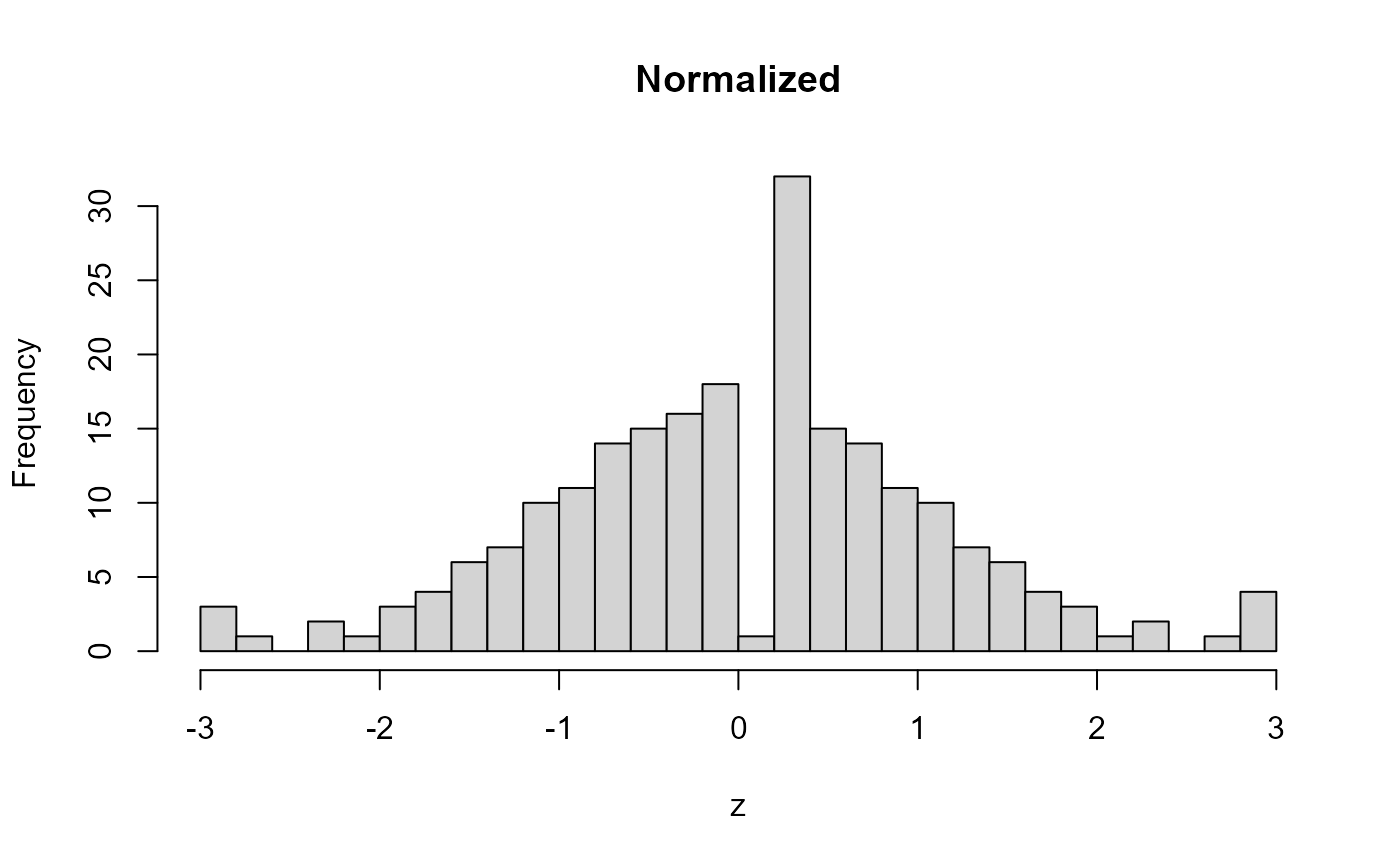
x <- c( NA, rnorm(200), rep(0, 20), 50, -50 )
# one-step normalize with auto-detected transformation
z <- normalize_x( x, range = "np", verbose = FALSE )
hist( z, breaks = 30, main = "Normalized" )
 # force a specific transformation
z_asinh <- normalize_x( x, range = "np", vtype = "asinh", verbose = FALSE )